
Punta Gorda Concrete vs Pavers: Which Is Better for Patios?
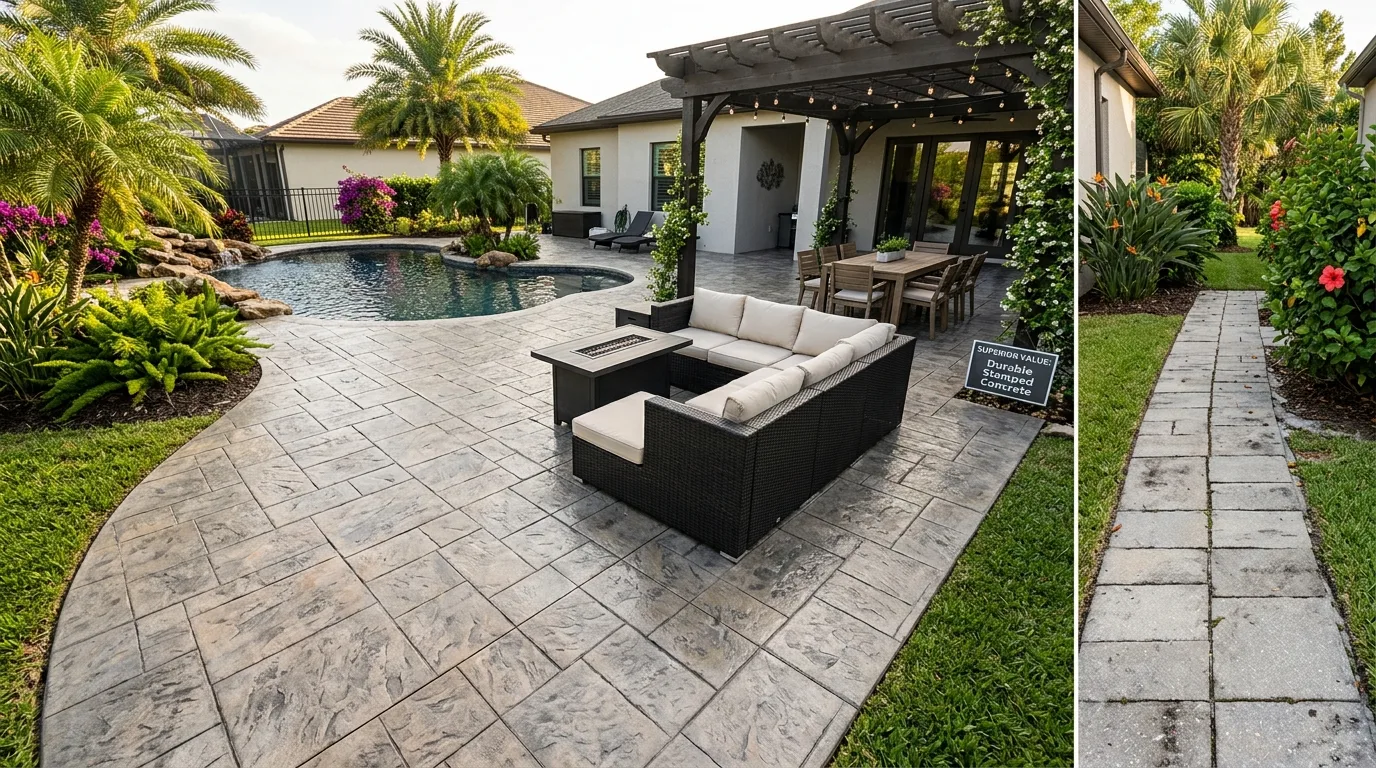
Should you choose concrete or pavers for your Punta Gorda patio, walkway, or pool deck? The debate runs in Charlotte County’s home improvement conversations because both materials have genuine merit — and both have specific failure modes in Punta Gorda’s conditions that homeowners should understand before investing. We install concrete, not pavers, so we can’t claim complete objectivity here. But we work in Charlotte County’s conditions every day, and this is an honest comparison of what each material does well and where each one disappoints in Punta Gorda’s subtropical environment.
Free Concrete Patio Estimates in Punta Gorda
Call (888) 376-0955 — concrete patio and decorative concrete specialists throughout Charlotte County.
How Punta Gorda’s Climate Affects Both Materials
Charlotte County’s wet season — 30+ inches of rain between June and October — is the primary stress test for outdoor hardscaping. Pavers are individual units with joints between them, and those joints require joint sand that wet season rainfall can wash away repeatedly. As joint sand depletes, paver units begin to shift, rock, and migrate. In Punta Gorda Isles and Harbour Heights, where sandy soils beneath pavers saturate quickly during heavy rain events, paver beds lose sub-base density and entire sections develop uneven surfaces within 3–5 years without proper maintenance.
Concrete’s advantage in this environment is monolithic: it moves as a unit rather than as individual pieces. Expansion joints are planned and sealed rather than maintained annually. The concrete surface doesn’t require re-leveling or joint sand replacement. Charlotte County’s UV intensity is where concrete’s advantage reverses slightly — UV-degraded sealer on concrete looks worse faster than faded paver color, though both require maintenance.
Side-by-Side Comparison for Punta Gorda Conditions
Initial cost:
- Concrete patio (standard): $5–$8 per square foot
- Stamped concrete (decorative): $8–$21 per square foot
- Concrete pavers: $8–$15 per square foot installed
Long-term maintenance:
- Concrete: Sealing every 3–5 years; crack repair as needed
- Pavers: Joint sand replacement annually in Charlotte County; re-leveling as individual units shift; full resetting when sections settle
Performance in Punta Gorda’s wet season:
- Concrete: Handles wet season well with proper drainage design; monolithic surface doesn’t shift
- Pavers: Joint sand depletes under heavy rainfall; wet season is the primary failure mechanism for pavers in Charlotte County
Repair flexibility:
- Concrete: Cracks and spalls require professional repair; color matching is difficult on aged stamped concrete
- Pavers: Individual units can be replaced; color matching is also difficult on aged pavers as new units are brighter
Appearance options:
- Concrete: Plain, broom, exposed aggregate, stamped patterns, integral color — full design range
- Pavers: Many color and shape options; individual unit variation creates natural aesthetic
Hurricane performance:
- Concrete: Stays in place during storm surge and high wind; doesn’t become projectiles
- Pavers: Can be displaced by storm surge; individual units become wind-driven projectiles in severe events
When Concrete Is the Better Choice in Punta Gorda
Pool decks. Concrete’s monolithic surface handles pool chemical splash without the joint-gap issues that pavers create. Pool areas in Punta Gorda Isles and Burnt Store Isles typically use concrete for this reason — the sealed, jointless surface is safer barefoot and easier to maintain in pool environments.
High-traffic walkways. Entry walkways, main patio paths, and driveway approaches see concentrated foot traffic that accelerates paver joint deterioration. Concrete handles traffic without the maintenance requirement.
Properties with active tree roots. In Charlotte County’s older neighborhoods where mature tree root systems run near the surface — common in the Historic Downtown District — concrete’s monolithic surface resists root heaving more gracefully than pavers, which get displaced one unit at a time.
Homeowners who want minimum annual maintenance. Concrete sealed every few years requires significantly less annual attention than pavers, which need joint sand attention after every heavy wet season rain event.
Cost-conscious projects. Standard concrete is typically less expensive than quality paver installation. When the budget is the binding constraint, concrete’s lower per-square-foot cost delivers a durable surface without the material premium of pavers.
When Pavers Have Advantages in Punta Gorda
Repair flexibility. If a vehicle tire or heavy object damages a paver, individual units are replaceable. Damaged concrete requires professional repair that may not match the surrounding surface perfectly.
Certain aesthetic preferences. Some Punta Gorda homeowners specifically want the visual texture and natural look of individual paver units — an aesthetic that stamped concrete approximates but doesn’t exactly replicate.
Projects without access to a concrete truck. Narrow lots or sites with access limitations that prevent concrete pump placement might favor pavers, which can be installed by hand without heavy equipment.
Punta Gorda Concrete Patio Specialists
Pattern concrete, pool decks, and plain slabs — free estimates at (888) 376-0955.
30-Year Cost Comparison for Punta Gorda Patios
For a 400 square foot patio in Charlotte County:
Concrete over 30 years:
- Installation (standard): $2,000–$3,200
- Sealing ×8: ~$600–$1,000
- Crack repair (1–2 events): ~$200–$400
- Total: ~$2,800–$4,600
Pavers over 30 years:
- Installation: $3,200–$6,000
- Joint sand replacement ×20: ~$1,000–$2,000
- Re-leveling events ×3–4: ~$1,500–$3,000
- Full resetting (likely once in 30 years): ~$2,000–$4,000
- Total: ~$7,700–$15,000
Pavers have higher initial cost and significantly higher maintenance cost in Charlotte County conditions — primarily because of the joint sand requirement that Punta Gorda’s wet season creates. The lifecycle math heavily favors concrete in most Charlotte County outdoor applications.
Practical Guidance for Punta Gorda Homeowners
If you’re deciding between concrete and pavers for a Punta Gorda outdoor project, the most important question is how much annual maintenance you want to do. Pavers require active maintenance after every significant wet season event; concrete requires periodic sealing and occasional crack repair. If low maintenance is a priority, concrete is clearly the better fit for Charlotte County conditions.
If aesthetics are the primary driver and you specifically want the look of individual paver units, understand that you’re accepting a higher maintenance commitment and a higher lifecycle cost. If you want premium aesthetics with lower maintenance, stamped concrete — particularly travertine or ashlar slate patterns — achieves a similar result with concrete’s durability. See our stamped concrete patios guide for design options.
Frequently Asked Questions
Can you switch from pavers to concrete in Punta Gorda?
Yes — paver removal and concrete installation is a common project in Charlotte County. The process involves removing the paver units and base material, compacting the sub-grade to the appropriate bearing capacity for concrete, forming, and pouring the concrete slab. Charlotte County permits are required for the new concrete. The demolished pavers can often be donated or sold rather than hauled away. Our concrete patio service page covers what the full conversion process involves.
Are pavers allowed in Punta Gorda HOA communities?
Most Charlotte County HOA communities allow both concrete and pavers for patios, pool decks, and walkways, but require ARB approval for either. Note that Charlotte County’s permit requirements specifically include pavers — a permit is required for paver flatwork just as for concrete flatwork. Some Punta Gorda Isles and Burnt Store Isles communities have style guidelines that favor one material or color over another; check your HOA docs before deciding. See our permit guide for details.
Do pavers or concrete handle Charlotte County’s hurricane season better?
Concrete handles hurricane conditions better in Charlotte County. Individual paver units can be displaced by storm surge, become wind-driven projectiles in severe events, and require complete resetting after flooding. Concrete’s monolithic construction stays in place and doesn’t create debris. Post-Ian, many Punta Gorda homeowners with displaced paver patios and pool decks replaced them with concrete for this reason. See our hurricane prep guide for concrete’s role in storm-resilient construction.
Upgrade Your Punta Gorda Outdoor Space With Concrete
Punta Gorda Concrete Company — (888) 376-0955 — concrete patios, pool decks, and walkways throughout Charlotte County.
Related: